Gracie Allen and AI’s Theater of Correction
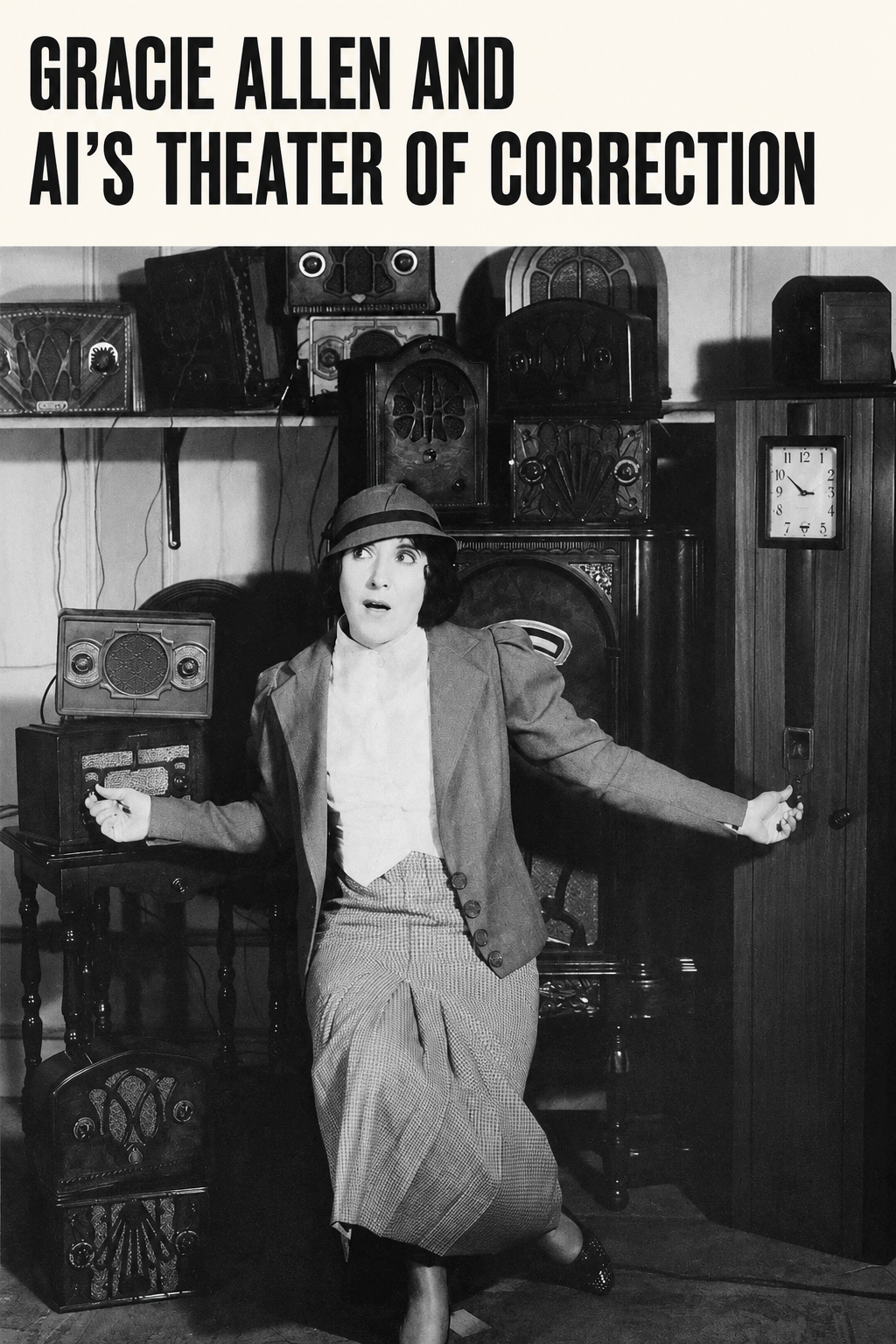
One of my favorite old comedy routines is a bit between George Burns and Gracie Allen. George would present some perfectly ordinary premise, and Gracie would respond as though she had discovered a profound flaw in his reasoning. She would then proceed through a winding chain of “illogical logic” that sounded like a correction while ultimately reaffirming George’s original point all along.
George:
“The train leaves at 5.”
Gracie:
“Well that can’t possibly be right, George, because if someone arrives after 5 they would miss it, which means it had already effectively left before 5 for them.”
George:
“…that is what leaving at 5 means.”
I’ve noticed a similar pattern in AI-generated commentary on my LinkedIn posts. A comment is framed as a correction, or even some critical intervention in the post's core claim:
“What sharpens this further…”
“The deeper tension is…”
“From another angle…”
At first, this can create the exciting possibility that the argument may move somewhere unexpected. But then the comment often arrives at something structurally very close to the original position, only redistributed in different terms.
The result can resemble a kind of academic Gracie Allen routine in which the rhetoric of correction creates the appearance of conceptual correction while the underlying idea remains completely intact.
This pattern reveals something important about AI-mediated discourse itself. LLMs do not sustain concepts through durable commitment across time. Instead, they continuously reorganize earlier patterns around the demands of the immediate response.
I call this asymmetrical answerability. Earlier articulations continue shaping later discourse, but the relation between them becomes unstable because the system does not inhabit time and thus remain answerable to prior formulations in the way human intellectual exchange does.
Stylistically, the trope reflects AI’s tendency toward simulated complexity: The appearance of conceptual depth produced through patterned language drawn from theoretical discourse. The logic here resembles that in another familiar tic of AI-generated prose: The compulsive “not x, but y” construction. The antithesis creates an immediate sensation of insight through the rhythm of contrast, despite the fact that the first term in the antithesis is often completely unnecessary. It’s a bit like saying:
"The grocery store was understood not as a liminal theater of posthuman abundance, but as a place to buy avocados and paper towels."
In both cases, the structure is fundamentally ironic: A gap between the appearance of insight and the actual lack of substance. The performance of correction thus becomes a substitute for advancing thought. This creates a particular problem for academic discourse, where the appearance of conceptual distinction is often treated as evidence that something intellectually new has occurred.
Comment on LinkedIn