Asymmetrical Temporalities in the Nonconscious Cognitive Assemblage: Why AI Dialogue Can Feel Temporally Shared Across Distinct Cognitive Architectures
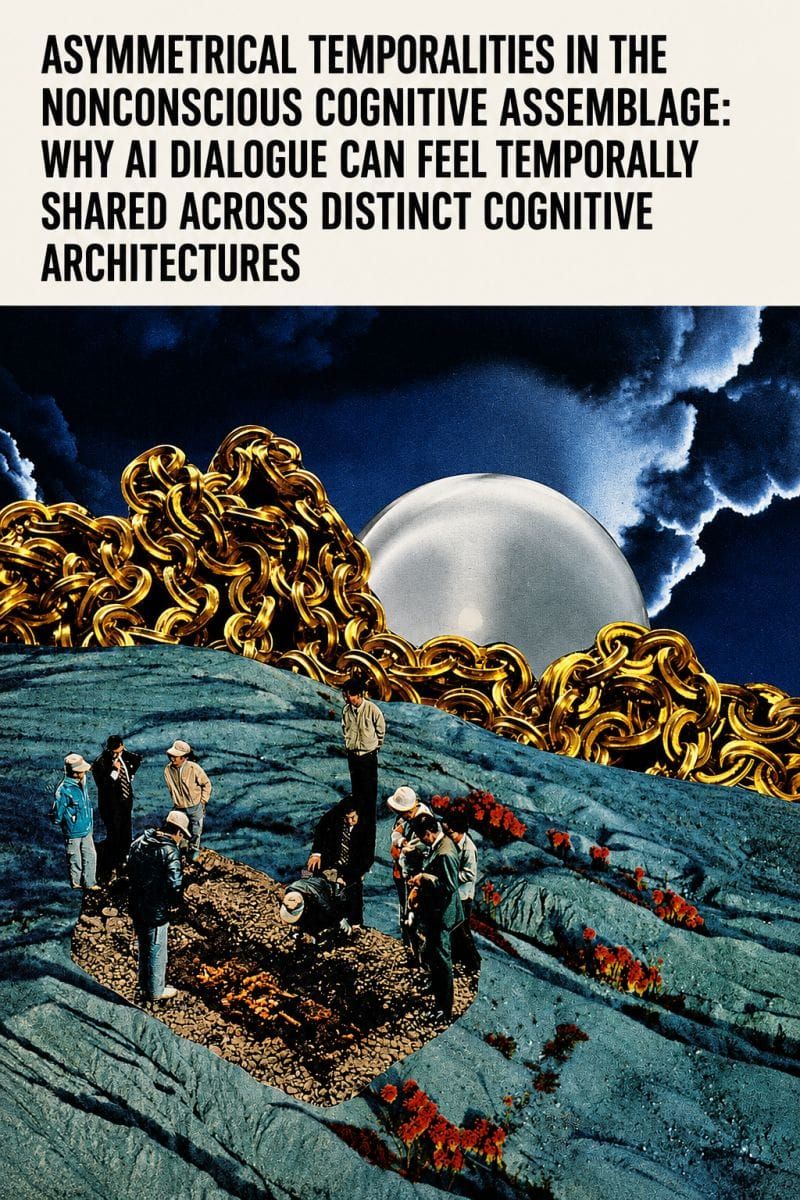
One of the strangest aspects of extended AI-human dialogue is that it can feel temporally shared even when the underlying cognitive architectures remain profoundly different.
Part of the reason involves what N. Katherine Hayles calls "nonconscious cognition." For Hayles, cognition is a process that interprets information by connecting it to contexts of meaning. This process does not require conscious awareness. Human dialogue unfolds through embodied processes of nonconscious interpretation that continue shaping attention, expectation, mood, and meaning long after a conversation appears finished.
A conversation from three days ago may still shape how someone reads a message today even when the earlier exchange can no longer be clearly recalled. Trust, irritation, attraction, suspicion, and conceptual readiness continue reorganizing meaning across time through affective carryover, autonomic response, anticipatory cues, and tacit pattern recognition. Human cognition thus retains prior interaction through embodied duration in time.
LLMs operate through a different temporal structure. Even when meaning appears continuous across long exchanges in an AI-mediated dialogue, the system recursively reconstructs contextual relevance inside bounded inferential windows for each exchange. Continuity emerges through probabilistic regeneration that selects certain elements of a dialogue while dropping others from one exchange to the next.
This creates an asymmetry in how cognition persists across AI-mediated dialogue. Human interpretation shifts because earlier interactions continue reorganizing meaning nonconsciously into the present. LLMs instead exhibit a kind of recursive presentism. Changes in meaning emerge because the model continually recalculates relationships among patterns within the active exchange, not from accumulated embodied experience across time.
What emerges is a feedback loop between distinct cognitive temporalities in which each continually modulates the other. Affective states, anticipatory tension, irritation, uncertainty, or emotional openness may shape tone, pacing, phrasing, and emphasis in human language beneath conscious awareness.
These patterns then enter the dialogue as cues that the model interprets within the active exchange, altering its own word choice, tone, and associative pathways in response. Those changes then feed back into the human participant’s ongoing conscious and nonconscious interpretation of the dialogue.
These recursive nonconscious processes shape the conscious experience of meaning within the exchange itself. The dialogue feels continuous at the level of language while operating through radically different temporal processes beneath it. This may be one way to understand the dynamics of what we might call the nonconscious cognitive assemblage.
Comment on LinkedIn