The Angel of Recursive History: The Past as Reconstituted Present in AI-Mediated Dialogue
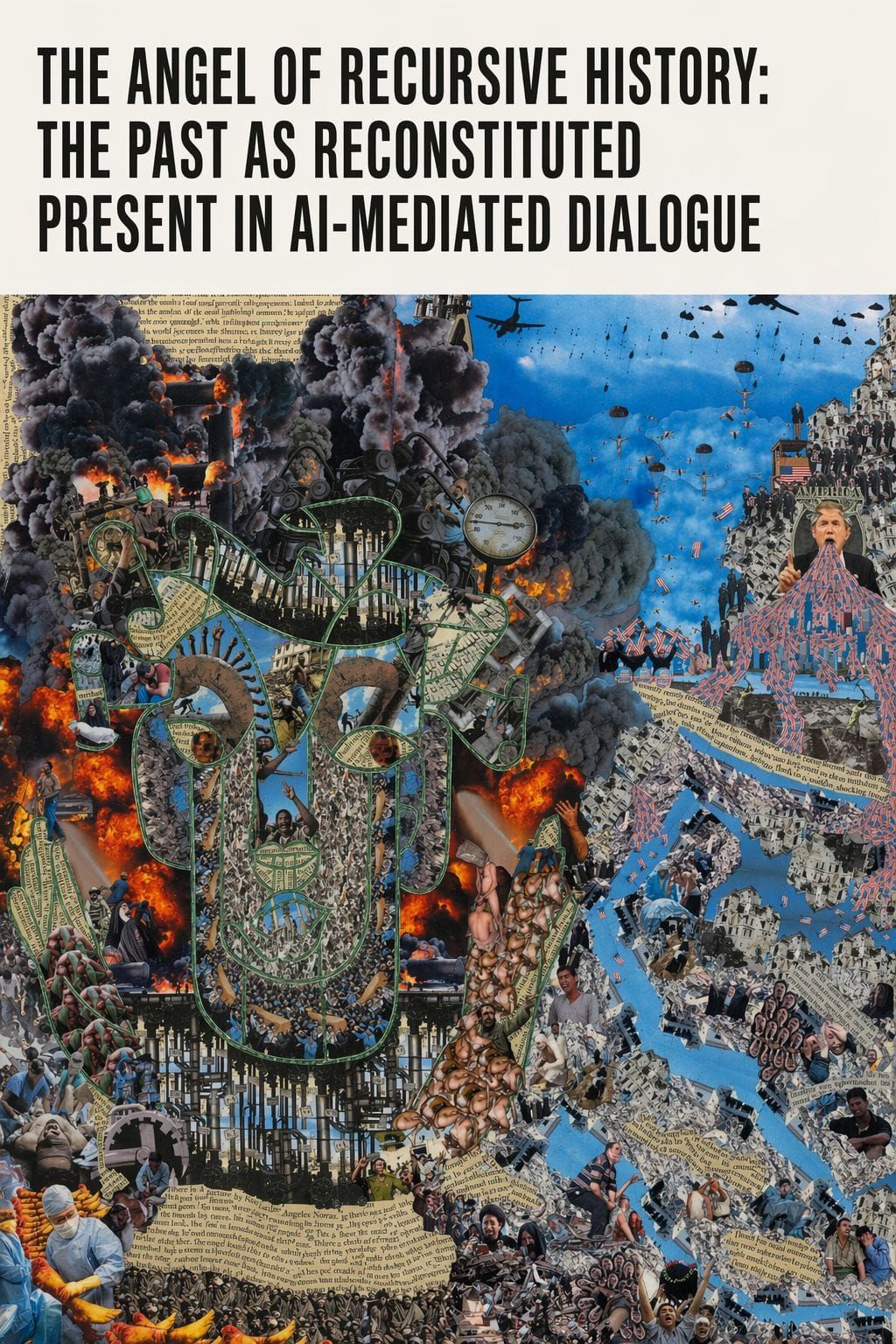
In his “Theses on the Philosophy of History,” Walter Benjamin reads Paul Klee’s Angelus Novus as an intervention into temporal perception. The angel faces the past and encounters no sequence of events, only a single, continuous image of catastrophe. In presenting an image, the text reorganizes the conditions under which temporal continuity—the experience of time as an ordered succession that can be revisited, narrated, and acted upon—becomes available to cognition.
The ability to interpret depends on that temporal continuity, a structuring of time in which events appear as discrete units that can be identified and integrated into a narrative sequence that supports reflection and response. Benjamin's text dramatizes the withdrawal of this condition by reconstituting that temporal spacing into a single image. The past no longer presents itself to the Angel as a differentiated field that can be re-entered. Presented only as an image, the past appears as accumulation without interval, equally present yet lacking the segmentation required for selective engagement. Like a photograph, the image renders history both present and inaccessible.
The storm of “progress” propels the angel forward, yet no longer organizes time into a trajectory that coordinates perception with the possibility of response. The angel is carried away from what it sees, even as that field remains fully exposed.
This displacement extends reflexively to the reader's encounter with the text. The difficulty of Benjamin’s text lies in its refusal to advance a theory through explicit conceptual exposition. It presents an image—of an angel that itself encounters an image—that disrupts any stable standpoint from which perception can be organized into interpretation. The reader, like the angel, encounters a scene that precedes the reflective work through which meaning would normally be coherently assembled.
What I call the cognitive intraface enacts a related temporal collapse within AI-mediated dialogue. It refers to recursive exchange between human and AI in which meaning is produced through successive turns that continuously reconfigure the past in the context of the present. Each turn recalculates the conditions under which prior language can register as meaningful, so that the relevance of the past is continually reconstituted rather than retrieved.
This temporal structure extends to the training corpus of the LLM, where prior discourse is condensed into a statistical field that remains operative in each output but cannot be accessed as a sequence of situated events. The past does not return as history. It functions as a condition of selection that shapes what can appear without restoring the contexts that would organize it.
In each of these mediations, the past persists as accumulation that conditions the present, while the structures that would permit its re-entry as sequence recede.