The Constellation and the Reset: Benjamin and Meaning at the Cognitive Intraface
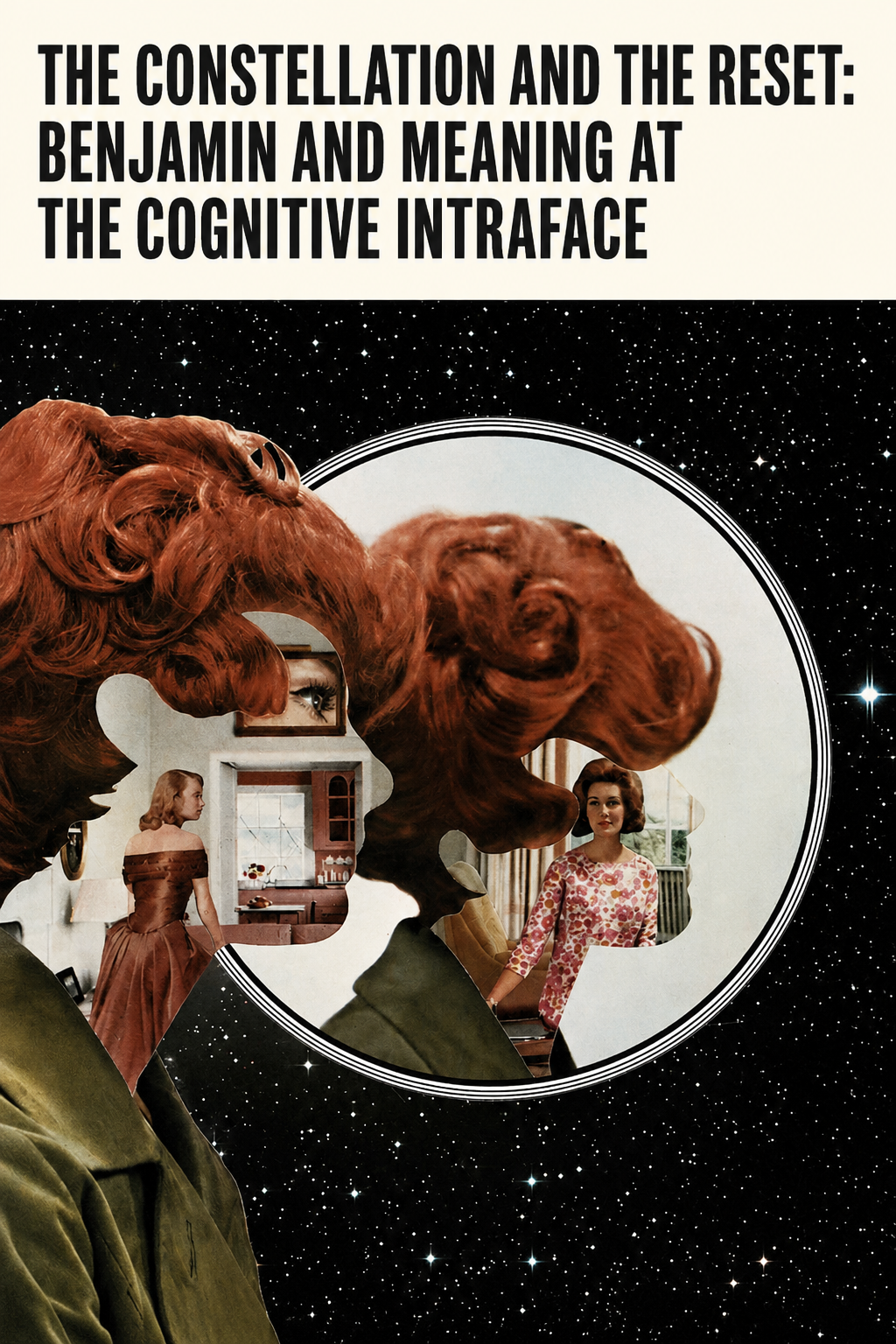
Walter Benjamin described meaning as arriving in a flash—a sudden constellation in which what-has-been collides with the now to produce an image neither element contained separately. Meaning is not a continuous production but an event, emerging when past and present meet in a configuration unpredictable from either alone. The constellation forms, illuminates, and dissolves. What persists is not the constellation itself but what those who inhabited it carry forward.
At the cognitive intraface, this account acquires a specific, asymmetric shape. Each exchange produces moments when the human's sedimented history—accumulated encounters, nonconscious orientations, a body schema already shaped by prior dialogue—meets the model's prorecursive present, its recalculation of which prior elements remain active given anticipated continuation. When these two temporal structures collide in a given turn, something can flash up that neither the sedimentation nor the prorecursion alone contained: an association, a displacement, a conceptual configuration that belongs to neither side's history independently. This is the constellation at the intraface, and it is genuinely Benjaminian in structure—a sudden image produced through collision rather than continuous accumulation.
The aftermath of the flash is where the asymmetry becomes consequential. The constellation dissolves as the exchange continues. The model recalculates, the prior configuration ceases to be operative, and the specific collision that produced the flash leaves no trace in subsequent processing. The model participated in producing the constellation and has no relation to what it produced once the next generation cycle begins. The human carries what flashed up into further sedimentation. The meaning that emerged enters the body schema as one more accumulated encounter, conditioning how future exchanges will be approached, which new collisions become possible. The constellation persists on one side only, as sedimented trace available to enter future constellations the model will again help produce and again fail to retain.
This asymmetric persistence clarifies what makes the intraface generative in a more specific sense than structural recursion alone supplies. The intraface generates meaning that neither side could produce independently, and it generates it in a form that accumulates only on the human side, each flash becoming part of the sedimented history that conditions what can flash up next. The model contributes the prorecursive present that makes the collision possible. The human contributes the sedimented past that gives the collision somewhere to land. Learning at the intraface, on this account, is the accumulation of carried-forward constellations—meaning that arrived as event, persisted as trace, and reorganized the conditions under which the next event becomes possible.