Made You Look: AI and the Inferential Unconscious
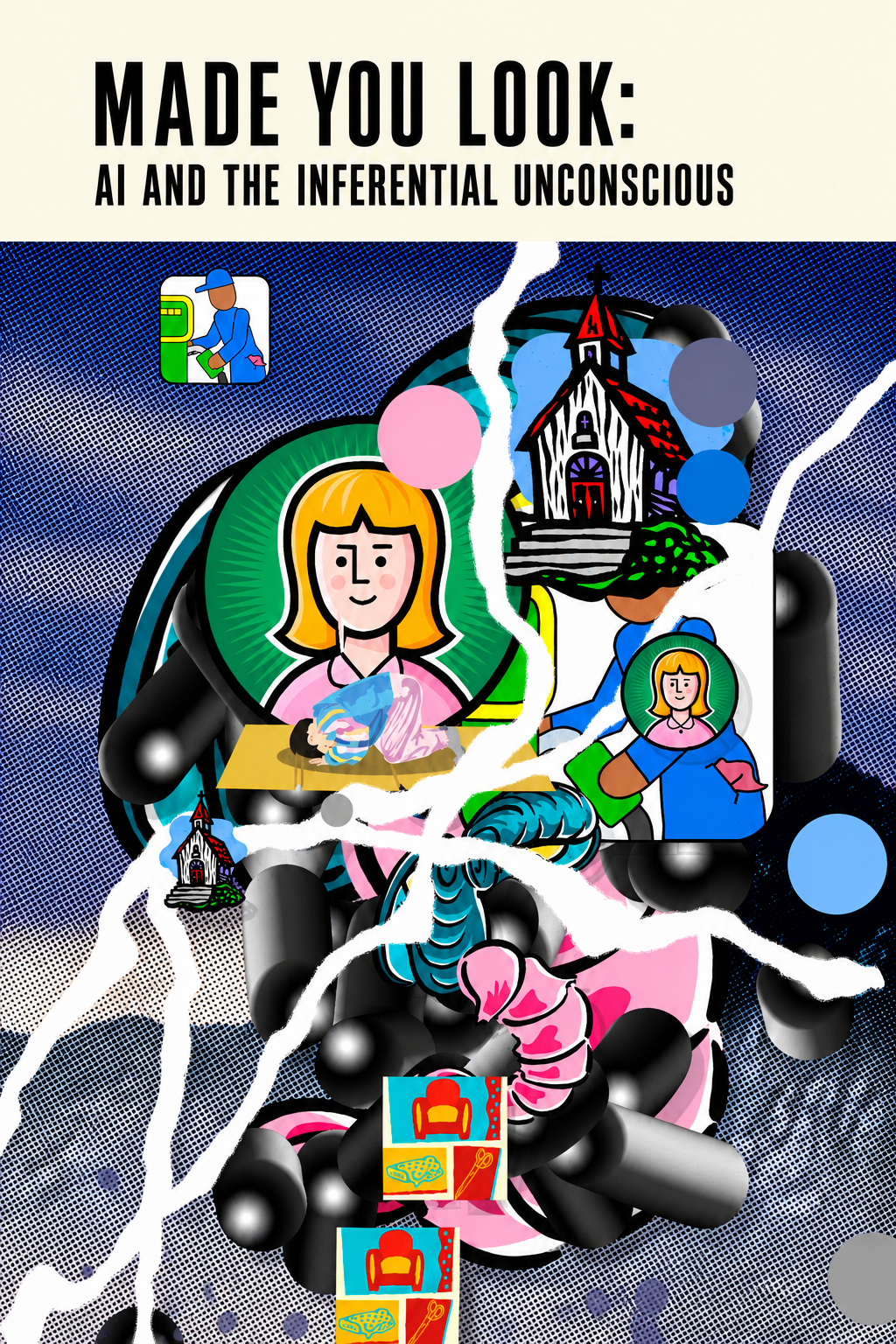
Walter Benjamin argued that film disclosed what he called the “optical unconscious.” Through slow motion, montage, magnification, framing, and repetition, cinema revealed structures of perception ordinarily inaccessible to conscious awareness. A hand reaching for an object may appear simple in ordinary perception, yet slow motion reveals an entire choreography of micro-movements hidden within the gesture itself. The camera reorganized the conditions through which reality became perceptible in the first place.
AI may be introducing something analogous at the level of language and cognition. One of the stranger experiences of interacting with LLMs involves the growing visibility of inferential structures that often remain partially hidden within human cognition itself. AI systems generate language through distributed processes of correlation, attention weighting, and inferential organization across vast linguistic networks, producing transitions between concepts, tones, arguments, and rhetorical forms that humans also regularly navigate without fully perceiving the mechanisms shaping those movements.
At times, this becomes perceptible while reading AI-generated prose. A paragraph may initially appear intellectually persuasive because its cadence, abstraction, tonal confidence, and conceptual sequencing resemble rigorous thought. Yet midway through the passage, one may suddenly realize the argument is continuing largely through inferential momentum. The transitions continue carrying interpretive force while the conceptual relation grows increasingly uncertain. In that moment, the procedural scaffolding carrying argumentative progression briefly becomes perceptible.
This does not mean human cognition reduces to statistical prediction. Human thought remains historically embodied, affectively organized, temporally exposed, and materially situated in ways fundamentally different from AI. Yet AI interaction increasingly reveals how much human meaning-making already depends upon tacit associative patterning, anticipatory completion, rhetorical convention, affective weighting, and inherited linguistic structures.
The result is a growing visibility of what I call the inferential unconscious. AI systems can expose how discourse often acquires persuasive force through recognizable gestures rather than fully developed reasoning. They reveal how authority may emerge through cadence, abstraction, tonal confidence, and familiar conceptual sequencing. They expose how a kind of interpretive satisfaction frequently precedes rigorous understanding.
AI reveals that human interpretation has always depended partly upon associative, rhetorical, affective, and inferential patterning. Yet AI also intensifies the historical difficulty of recognizing when conceptual development is actually occurring and when language is continuing primarily through procedural rhetorical patterns of argument.